
First-Time Exhibitors in Dubai:
A Practical Guide to Planning, Compliance and Execution
Exhibiting in Dubai for the first time can feel complex—not because the process is unmanageable, but because many of its critical rules, roles and dependencies are unfamiliar to new participants. Unlike markets where exhibition delivery is loosely structured, Dubai operates within a tightly regulated ecosystem where venue rules, approval procedures, logistics coordination and on-site execution are closely interconnected. For first-time exhibitors, understanding this structure early is often the difference between a controlled project and a reactive one.
Many challenges faced by new exhibitors do not stem from design ambition or budget size, but from misaligned expectations. Approval requirements are often underestimated, timelines assumed to be flexible, and logistics treated as a downstream task rather than a core planning discipline. As a result, issues tend to surface late—when options are limited, costs escalate and on-site pressure increases.
This guide is designed to help first-time exhibitors navigate Dubai’s exhibition environment with clarity and confidence. It explains where to start, how responsibilities are divided between venues, organizers and contractors, and why early decisions shape every later outcome. Rather than offering checklists or event-specific instructions, the focus is on understanding how the system works—so planning, compliance and execution can be approached as a coordinated project, not a series of last-minute fixes.
By setting realistic expectations and highlighting common early-stage pitfalls, this guide aims to reduce uncertainty and help international exhibitors approach their first Dubai exhibition as a structured, manageable process—one that rewards preparation, coordination and informed decision-making.
Where First-Time Exhibitors in Dubai Should Start
For companies exhibiting in Dubai for the first time, the most important step is understanding the structure of the exhibition ecosystem before making any design or budget decisions. Dubai exhibitions are not driven by a single authority; they operate through a clearly defined system of roles, approvals and controls. Entering this system without understanding who does what is the primary source of confusion for first-time exhibitors.
At the core of the ecosystem are three distinct actors: the venue, the event organizer, and the exhibition contractor. Each controls a different layer of the project, and their responsibilities do not overlap as much as first-time exhibitors often assume.
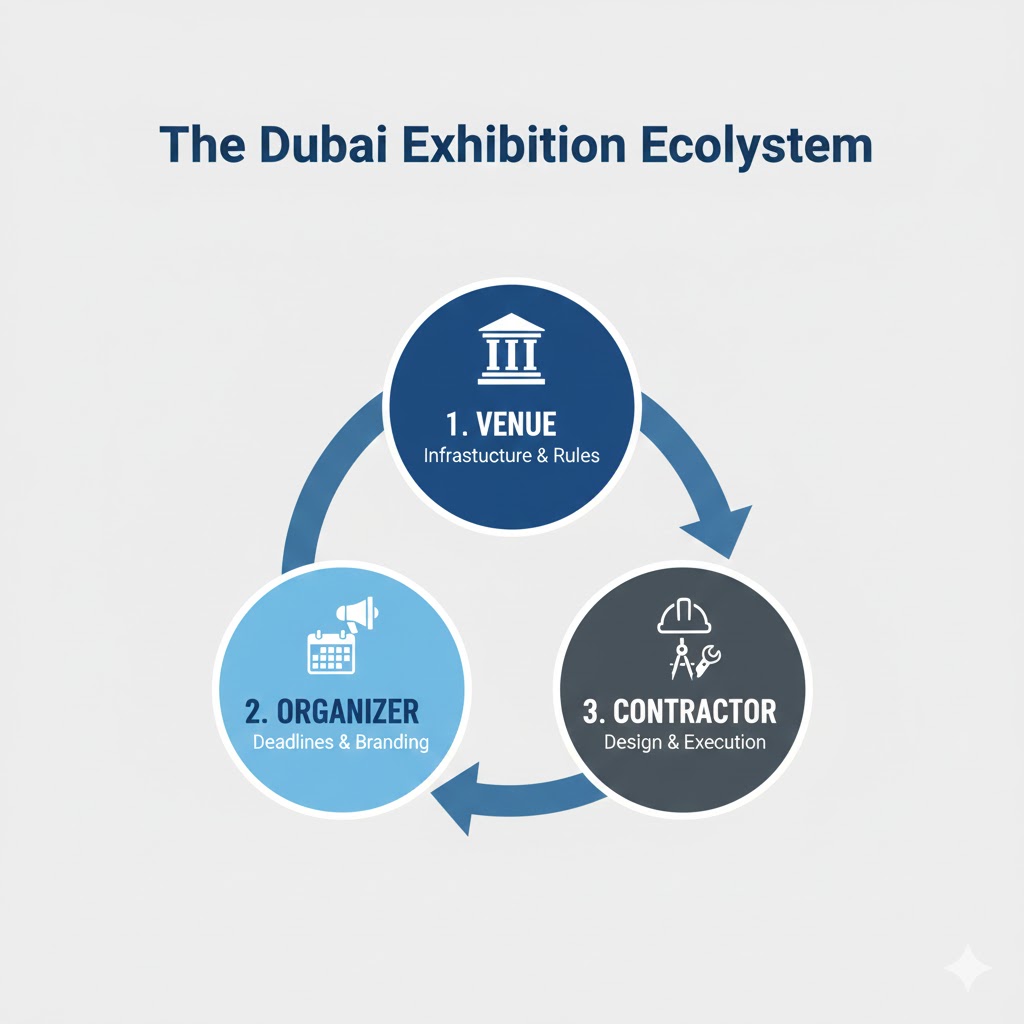
The venue—such as Dubai World Trade Centre or Expo City Dubai—controls the physical environment. This includes hall infrastructure, access rules, structural limits, safety enforcement and on-site operations. Venue rules define what is physically and technically possible, regardless of design intent or budget.
The event organizer sits above the venue layer and defines the exhibition framework. Organizers set participation rules, deadlines, submission requirements and, in some cases, standardized stand formats such as shell schemes. While organizers do not build stands, they control the approval pathways that determine whether a stand is allowed onto the exhibition floor.
The exhibition contractor operates within both of these frameworks. Contractors translate design intent into technical documentation, manage approvals, coordinate logistics and execute build-up and dismantling on-site. For first-time exhibitors, the contractor is often the only party actively managing how venue rules and organizer requirements are applied in practice.
The reason first decisions matter so much is that these roles are sequentially linked. Choosing a stand type selection affects approval scope. Approval scope affects timeline pressure. Timeline pressure affects logistics, handling and cost exposure. Early assumptions—such as treating approvals as a formality or assuming logistics can be finalized later—tend to cascade into problems that surface only during build-up, when corrective options are limited.
This is why first-time exhibitors should reframe their starting point. The objective is not to “get a stand built,” but to plan an exhibition project. That project includes design, approvals, logistics, installation, compliance and breakdown as interdependent phases. When these phases are considered together from the outset, decisions become more grounded and risks more visible.
Starting with a clear understanding of who controls what—and how early choices shape later constraints—creates a stable foundation for everything that follows. For first-time exhibitors in Dubai, this mindset shift is often the single most effective step toward a controlled and predictable exhibition experience.
Why Working with a Local Exhibition Contractor Is Critical
For first-time exhibitors in Dubai, working with a local exhibition contractor is less about convenience and more about risk control. Dubai exhibitions operate within tightly enforced technical, safety and operational frameworks that are difficult to manage remotely without direct, on-the-ground experience. Local contractors function as the interface between design intent and the realities of venue rules, approval systems and on-site enforcement.
Local rule knowledge and venue familiarity are the primary advantages. Each major venue—such as Dubai World Trade Centre or Expo City Dubai—applies shared principles differently in practice. Access timing, delivery slot behavior, inspection routines and enforcement thresholds are shaped by how each venue operates during build-up. These nuances are rarely documented in full and are learned through repeated execution. A local contractor anticipates these conditions rather than reacting to them.
Approval, HSE and handling processes are where local expertise has the most measurable impact. Technical submissions must align with venue expectations, not just formal guidelines. HSE reviews assess not only drawings, but installation methods and site behavior. Handling and logistics coordination depend on knowing how delivery slots, manpower and equipment are actually allocated during peak build-up periods. Local contractors navigate these processes as a single, integrated workflow, reducing the likelihood of rejected submissions, delayed access or on-site intervention.
Time and budget risks are also managed earlier when a local contractor is involved. Potential issues—such as approval sensitivity, handling constraints or installation sequencing conflicts—are identified during planning rather than discovered during build-up. This allows design adjustments, logistics decisions or scope refinements to be made while options still exist. Projects managed remotely often surface these risks too late, when mitigation requires overtime, expedited services or enforced compromises that inflate cost and reduce control.
The most common mistake made by first-time exhibitors is assuming that a project can be “managed from afar” once design direction is set. In Dubai, distance amplifies uncertainty. Remote coordination typically leads to fragmented responsibility, slower response to approval feedback and delayed reaction to on-site changes. When issues arise—and they often do—the absence of local authority and immediate presence turns manageable deviations into cascading delays.
Working with a local exhibition contractor does not eliminate complexity, but it contains it. The value lies not in selling a solution, but in absorbing variability: translating rules into actionable decisions, aligning approvals with execution, and stabilizing timelines and budgets through informed planning. For first-time exhibitors, this local grounding is often the difference between a controlled learning experience and a reactive one shaped by last-minute surprises.
Common Mistakes Made by First-Time Exhibitors
First-time exhibitors in Dubai tend to encounter similar challenges, not because the environment is unpredictable, but because key project realities are underestimated. These mistakes are rarely technical in nature; they stem from assumptions carried over from other markets where approval, logistics and on-site control operate with less intensity.
Underestimating time requirements is the most frequent error. Many first-time exhibitors assume that once a stand concept is approved internally, execution can proceed quickly. In Dubai, timelines are shaped by approval cycles, venue access rules, delivery slots and coordinated build-up schedules. Treating time as flexible reduces buffer capacity and turns minor delays into critical disruptions.
Treating approvals as a formality is another common misconception. Approval processes in Dubai are not symbolic checkpoints; they are technical gatekeepers. Detailed drawings, method statements and compliance documentation are actively reviewed, revised and enforced on-site. When approvals are approached late or superficially, projects face revision loops, conditional access or last-minute restrictions that directly affect installation.
Viewing the budget only as stand production cost creates blind spots. First-time exhibitors often focus on design and fabrication while overlooking approval-related revisions, handling services, overtime labor, technical services and logistics variability. These elements are not optional extras; they are integral to delivery. When they are excluded from early budgeting, cost escalation appears sudden but is, in reality, structural.
Delaying logistics and handling decisions compounds all other issues. Shipping methods, customs strategy, delivery slot booking and on-site handling coordination directly influence whether materials arrive on time and can be installed as planned. When logistics is treated as a post-design task, approvals may be ready but materials unavailable, or build-up windows may close before installation is complete.
To help you navigate these complexities, here is a quick reference to the most common pitfalls and how to avoid them:
Common Mistake | Impact | Professional Advice |
Treating approvals as a formality | 11th-hour design changes, site access rejection, or enforced modifications. | Start detailed technical drawings and the approval process at least 8 weeks before the show. |
Underestimating venue logistics | Delayed material arrival, long forklift queues, and expensive overtime labor. | Book your venue handling and delivery slots at least 14 days before the build-up begins. |
Ignoring the “Design Freeze” | Escalating costs due to the “Multiplier Effect” of late-stage revisions and rush printing. | Finalize all design and branding changes 14–21 days before on-site move-in. |
Budgeting only for fabrication | Sudden 20–30% budget escalation due to hidden venue, HSE, and technical service fees. | Include a clear contingency line for Mandatory Venue Services and HSE compliance in your initial budget. |
These mistakes are closely linked. Underestimating time leads to rushed approvals; rushed approvals increase revision and handling costs; delayed logistics compress build-up windows and amplify risk. The result is not a single failure point, but a cascade of avoidable pressure across the project.
This is why this section resonates strongly with first-time exhibitors. The challenges described here are not warnings meant to intimidate, but patterns that can be corrected early. When time, approvals, budget and logistics are treated as interconnected elements of a single project—rather than isolated tasks—most first-time risks in Dubai exhibitions become manageable rather than disruptive.
Timeline Challenges for First-Time Projects
Timeline planning is where first-time exhibition projects in Dubai encounter the greatest friction. The challenge is not a lack of effort, but a lack of familiarity with how tightly design, approvals, HSE reviews and venue operations are interlocked. Without this context, schedules that appear reasonable on paper become fragile under real conditions.
The absence of a clear design freeze is a primary issue. First-time exhibitors often assume that design can evolve continuously until build-up begins. In Dubai exhibitions, however, approvals, material procurement and installation sequencing depend on stable, finalized drawings. When design decisions remain fluid, every change resets parts of the approval and production cycle, consuming time that cannot be recovered later.
Last-minute changes create a chain reaction. What seems like a minor adjustment—moving a wall, adding a screen, changing finishes—can trigger revised technical drawings, updated approvals, modified logistics plans and altered installation methods. Each revision introduces new review time and coordination effort. For first-time projects, these cascading effects are rarely anticipated, leading to compressed build-up windows and increased execution risk.
Approval and HSE processes exert direct pressure on timelines. These reviews do not run in parallel by default; they are conditional on submitted information being complete, consistent and compliant. Incomplete submissions or late clarifications extend review cycles, delaying downstream activities such as production release, shipping and on-site access. HSE requirements further influence when and how installation can proceed, particularly for complex structures or working-at-height activities.
Early planning is therefore not about starting sooner, but about reducing uncertainty. When key decisions are made early—stand type, structural approach, logistics strategy and approval scope—project timelines gain resilience. Buffers can be built into critical stages, alternative scenarios can be prepared, and dependencies become visible rather than emergent.
For first-time exhibitors, the lesson is clear: timelines in Dubai are not linear checklists; they are interdependent systems. Managing them successfully requires locking decisions at the right moments, understanding where flexibility exists—and where it does not—and coordinating design, approvals and logistics as a single planning exercise. This perspective transforms timeline management from a source of pressure into a tool for control.
Why Approval Processes Surprise First-Time Exhibitors
Approval processes are one of the most unexpected pressure points for first-time exhibitors in Dubai because they are often misunderstood as a formality rather than a technical gatekeeping system. Many international exhibitors approach approvals assuming that basic layouts or visual concepts are sufficient. In reality, approvals in Dubai are structured, detail-driven and directly tied to on-site access and execution rights.
Unfamiliarity with technical drawing expectations is the first source of surprise. Venues and organizers do not review stands based on visuals alone. They expect coordinated technical drawings that clearly define structure, materials, dimensions, fixing methods, electrical layouts and safety provisions. First-time exhibitors frequently underestimate this requirement, submitting incomplete or presentation-level documents that cannot be assessed for compliance, triggering revision requests and timeline delays.
Revision cycles are often not anticipated. Approval is rarely a single-step process. Feedback loops are common, especially where stand designs introduce structural elements, enclosed spaces, elevated features or non-standard installations. Each revision requires updated drawings, resubmission and additional review time. First-time projects often fail to allocate time and resources for these cycles, assuming that approval will be granted once documents are “submitted.”
In Dubai, a “Submission” does not equal an “Approval.” The venue and HSE inspectors often request structural revisions even for standard designs. Never release your final production before receiving the Final Approval Certificate to avoid costly rework.
A deeper issue lies in the perception that a stand is “just a stand.” This mindset overlooks the fact that exhibition stands in Dubai are treated as temporary buildings within controlled environments. They are evaluated for structural integrity, fire safety, electrical load, access control and technical submissions related to operational risk. What may seem like a simple design feature to an exhibitor can carry regulatory implications that require formal justification and documentation.
Perhaps the most critical misunderstanding is the relationship between approval and site access. Approval is not an abstract compliance step; it is a prerequisite for entering the venue, starting installation and passing inspections. Without approved drawings, production may be halted, materials may not be released for build-up, and installation teams may be denied access. For first-time exhibitors, this direct linkage between paperwork and physical progress is often only realized when delays occur.
These surprises do not stem from excessive regulation, but from misaligned expectations. Approval processes in Dubai are predictable when understood correctly, but unforgiving when underestimated. This is why early engagement with approval requirements—understanding documentation depth, revision logic and submission sequencing—is essential. When approvals are treated as an integral part of project planning rather than an administrative hurdle, first-time exhibitors regain control over timelines, costs and on-site execution.
Budget Blind Spots for First-Time Exhibitors
Budget overruns for first-time exhibitors in Dubai rarely come from the visible cost of the exhibition stand itself. They typically emerge from secondary and tertiary cost layers that are not fully understood at the planning stage. These blind spots do not reflect poor budgeting discipline; they reflect unfamiliarity with budgeting and commercial terms and how exhibition projects behave under real operational conditions.
On-site handling, overtime and additional services are among the most frequently overlooked items. Venue-controlled services such as forklift handling, manpower support, extended working hours and supervised access are not optional add-ons—they are operational requirements triggered by delivery timing, material volume and installation complexity. When build-up schedules compress or deliveries arrive outside optimal windows, overtime and additional handling become unavoidable, pushing costs beyond initial estimates.
Approval revision costs are another common surprise. Each design revision triggered by venue or organizer feedback carries a cost impact, even if it appears minor. Redrawing technical documents, reissuing calculations, adjusting production details or coordinating additional reviews consumes time and resources. First-time exhibitors often budget for “approval” as a single line item, without accounting for the likelihood of iterative revisions—particularly for non-standard designs.
Last-minute logistics expenses create a third layer of budget exposure. Delays in approvals, late design changes or incomplete documentation frequently force expedited shipping, emergency local sourcing or rapid re-handling of materials already on-site. These reactive measures are significantly more expensive than planned logistics and are often implemented under time pressure, when cost control options are limited.
Underlying all of these issues is a misconception that exhibition budgets are static. In practice, exhibition budgets are dynamic systems that respond to timing, compliance progress and operational decisions. Costs expand not because projects are mismanaged, but because certain dependencies—approvals, access windows, coordination sequences—were not fully priced into the original scope.
For first-time exhibitors, the key lesson is not to inflate budgets defensively, but to understand where variability lives. When handling assumptions, approval behavior and logistics timing are acknowledged early, budgets become more resilient and predictable. This perspective aligns budgeting with operational reality, reducing surprise costs and supporting more confident decision-making throughout the project lifecycle.
Logistics and Customs Considerations for New Exhibitors
For first-time exhibitors in Dubai, logistics and customs are often underestimated because they take place outside the exhibition venue yet directly determine whether installation can begin on time. Unlike design or fabrication—which are visible and easier to track—logistics and import processes operate within regulatory, scheduling and documentation frameworks that leave little room for correction once timelines tighten.
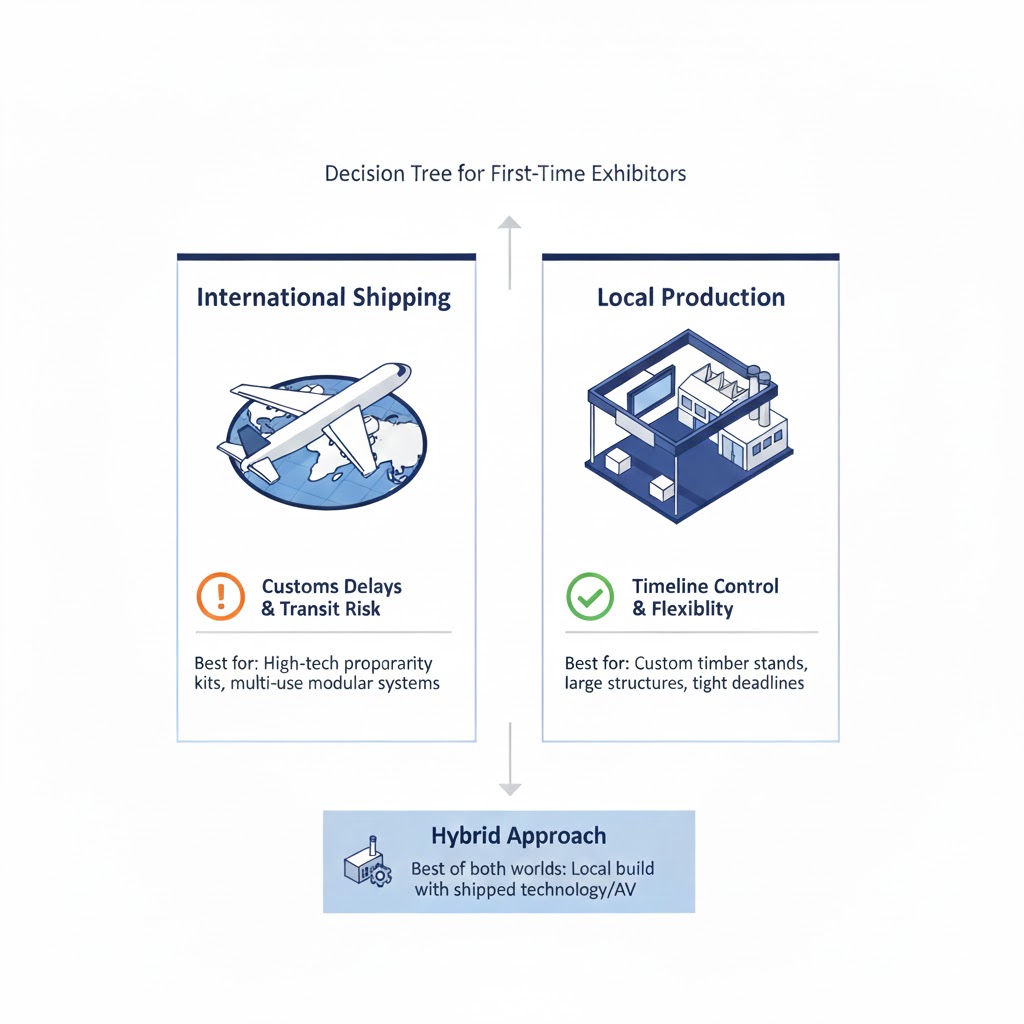
One of the earliest strategic decisions is shipping materials internationally versus producing locally. Shipping may appear straightforward, especially for exhibitors accustomed to moving stands between regions, but it introduces dependencies on transit time, customs clearance and delivery slot availability. Local production reduces border-related uncertainty and allows tighter alignment with venue delivery rules, handling coordination and approval timing. For first-time projects, local or hybrid approaches often provide greater schedule control, even if the design intent originates elsewhere.
ATA Carnet and temporary import procedures are another frequent source of confusion. An ATA Carnet enables temporary, duty-free import of exhibition materials on the condition that they are re-exported after the event. Temporary import without an ATA Carnet or temporary import follows a different process and usually involves financial guarantees and more extensive local handling. Selecting the wrong import method—or misaligning shipment contents with documentation—can trigger inspections, delays or reclassification at customs. These issues rarely surface early; they emerge when materials arrive, at which point recovery options are limited.
The impact of customs delays on on-site execution is often more severe than expected. Exhibition build-up windows in Dubai are fixed and highly controlled. If materials are delayed at customs, installation teams lose access time that cannot be recovered. This leads to compressed schedules, reduced installation scope or forced simplification of the stand. Even when approvals are fully in place, the absence of physical materials means work cannot proceed—highlighting that documentation alone does not secure readiness.
These risks explain why logistics planning must begin early, alongside design and approval discussions rather than after them. Early planning allows shipment strategies, import methods and delivery timing to be aligned with approval milestones and venue access rules. It also creates space to build contingencies—such as phased delivery, local sourcing alternatives or adjusted installation sequencing—before they are urgently needed.
For new exhibitors, the key takeaway is that logistics and customs are not administrative tasks to be delegated late in the process. They are structural components of project planning that influence cost stability, schedule certainty and on-site control. When addressed early and integrated with design, approvals and timeline management, logistics becomes a stabilizing factor rather than a source of last-minute disruption.
Design Expectations Specific to Dubai Exhibitions
Design expectations in Dubai exhibitions are shaped by a combination of scale, international audience profile and highly competitive show environments. For first-time exhibitors, the challenge is not simply to create an attractive stand, but to meet unspoken benchmarks around visibility, functionality and execution quality that are widely understood within the local exhibition ecosystem.
Visibility and perceived prestige play a central role. Dubai exhibitions typically feature large halls, wide aisles and high stand density, which means visual presence must work at distance as well as up close. Stands are expected to read clearly from multiple approach angles, with strong architectural identity rather than reliance on surface graphics alone. Height, lighting composition and spatial clarity often signal brand seriousness more than decorative detail.
At the same time, functionality is non-negotiable. Dubai exhibitions place strong emphasis on business interaction, not just display. Meeting areas—whether open, semi-private or enclosed—are a standard expectation rather than a luxury. These spaces must be integrated into the stand layout without compromising circulation, visibility or compliance. A stand that looks impressive but fails to support meetings, product demonstrations or staff workflow is quickly perceived as underperforming.
Traffic density and flow planning are also critical. High visitor volumes, especially during peak show hours, require layouts that manage movement intuitively. Narrow entrances, dead ends or poorly defined zones create congestion and reduce engagement. Effective designs anticipate how visitors enter, pause, interact and exit, ensuring that key brand elements remain accessible even under crowd pressure. Flow planning is therefore both a design and an operational concern.
Perhaps the most important expectation is finding the balance between “showcase impact” and practical execution. Dubai rewards ambition, but only when it is deliverable within approval rules, build-up constraints and on-site conditions. Overly complex concepts that rely on fragile details, extreme tolerances or last-minute improvisation often encounter approval friction or installation issues. Successful designs achieve impact through controlled structure, disciplined detailing and materials that perform reliably in real exhibition conditions.
For first-time exhibitors, understanding these expectations helps recalibrate design decisions early. The goal is not to compete on extravagance, but to align visual ambition with functional clarity and technical feasibility. In Dubai exhibitions, the most effective stands are those that appear confident, well-resolved and operationally sound—demonstrating that strong design is inseparable from planning, compliance and execution discipline.
Important Note for First-Time Exhibitors
- First-time exhibition projects involve learning curves and regulatory requirements
- Early coordination with local experts reduces risk and cost
- Most issues are preventable with proper planning
Venue Rules & Local Regulations (DWTC & Expo City) →
Approval Process & Technical Submissions →
HSE, Risk Assessment & Safety Compliance →
Electrical, Lighting, AV & Network Requirements →
Rigging, Suspended Structures & Double Decker →
Logistics, Handling, Storage & Customs →
Exhibition Stand Types in Dubai →